
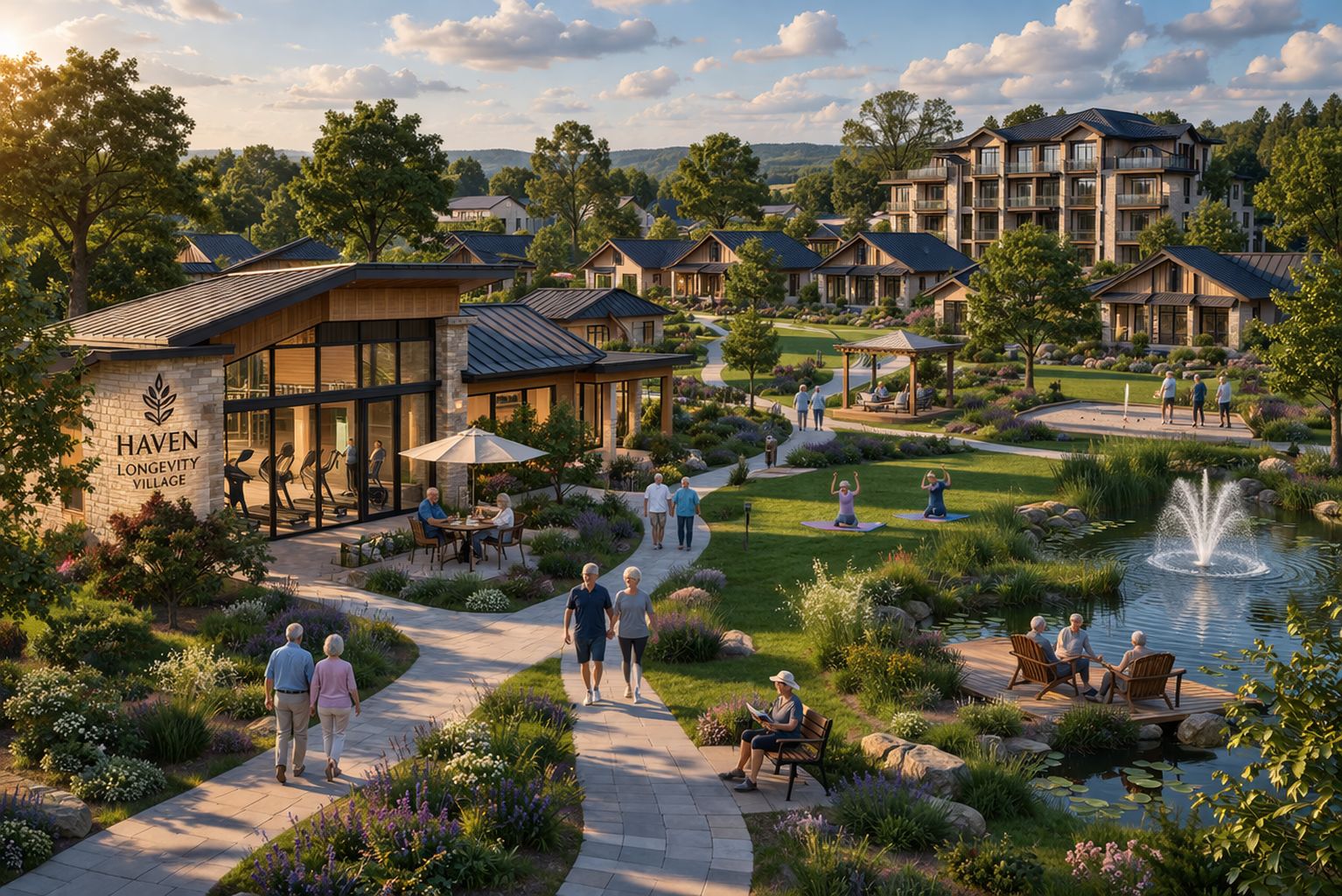
There is a certain kind of quiet that settles over people as they age. Not always the peaceful kind. Sometimes it is the quiet of loss.
The quiet that comes after careers end, children move away, friends pass on, and the world begins to feel a little less connected than it once did.
Smaller circles. Smaller hopes. Smaller expectations.
It should feel fuller.
Set against the open sky and grounded beauty of North Texas,
this village is imagined as more than a place to live.
It is a place to begin again.
It is the feeling of being known by name. Of being greeted with warmth. Of having neighbors who become dear friends. Of hearing laughter from a courtyard, music from a gathering space, and conversation that reminds you that you still belong to something meaningful.
Every resident is a person, not a patient. Warmth and personal attention are the standard here, not the exception.
Neighbors who become dear friends. Courtyard laughter. Music from gathering spaces. A reminder that you still belong to something meaningful.
Beauty around you. Purpose in front of you. Mornings with sunlight through the trees, walks along landscaped paths, and a life that still has something ahead.
Not merely cared for — honored. Families can exhale. Residents feel the difference between existing somewhere and being rooted somewhere.
A walk along beautifully landscaped paths. The quiet reassurance that your life is not winding down into isolation — it is opening into connection.
This is a village for people who do not want to disappear into the background. It is for those who still want beauty around them and purpose in front of them.
In Decatur, where community still matters and the pace of life allows room to breathe, Haven Longevity Village is designed to feel like refuge without feeling removed from life.
Elevated, but still deeply personal. A place where wellness, hospitality, and belonging meet.
Where residents can feel — truly feel — the distinction. Not just housed, but home. Not just managed, but known. Not just safe, but seen.
And perhaps most importantly, it is a place that tells a better story about aging.
Beautifully designed spaces, landscaped grounds, and an environment built to delight the senses every single day — not just at move-in.
Programming, wellness, community, and connection that keep life moving forward — not winding down. Something to look forward to, every day.
Not merely cared for. Not managed. Honored — in the way that recognizes a whole life lived and affirms that it still has chapters worth reading.
The peace of knowing the people you love are in a place designed with intention, warmth, and deep respect — not just for their safety, but for their joy.
Real neighbors. Real conversations. A community where lasting friendships form naturally — over meals, walks, gatherings, and shared mornings.
Haven is for anyone who senses that this season of life still holds something good — and is ready to step into it with both feet.
Haven Longevity Village is meant to feel like coming home to a life that still has richness ahead — a life filled with movement, beauty, friendship, peace, and purpose.
Decatur is not incidental to this village — it is part of what makes it work. North Texas at its most human: open sky, room to move, and a genuine sense of place that most communities have long since paved over.
Haven is designed to feel like refuge without feeling removed from life.
And in Decatur, Texas, we believe they can.
Learn more about HavenA two-parcel, 37.62-acre mixed-use longevity development in the DFW market, structured as two operationally distinct districts under a single brand.
The two-parcel structure is not a constraint — it is the value-creation strategy. Separating clinical and residential uses produces four distinct advantages.
Phase I is only financeable if these five conditions are confirmed before capital launch.
Three decisions must be made before this project can move from planning brief to active deal.
Resolve Option A (single entity) vs. Option B (bifurcated) before LOI strategy is finalized — not merely before general structuring conversations. The structure choice governs investor selection, waterfall design, and operating agreement architecture. See Exhibit C for full comparison and decision triggers.
Execute option or PSA with extension rights tied to diligence milestones. ESA and title review before hard money.
Engage land-use counsel, civil/traffic, and geotech immediately. These are the critical-path items that govern everything downstream.
This is a conceptual predevelopment planning brief — not an investment memorandum, not an entitlement package, and not a financial pro forma. It establishes the strategic planning framework and development thesis required to begin Stage One of the deal path. All program figures, costs, and yield estimates are indicative and require formal validation.
The recommended approach is a two-parcel master plan — not a blended campus plan. Each parcel receives a distinct, operationally independent program under a single brand.
Haven Longevity Village is a two-parcel master-planned development combining a private residential wellness campus with a public-facing longevity and clinical village — conceived as a seamlessly branded, operationally distinct experience.
This pre-plan establishes the strategic planning framework across 37.62 acres, separating residential life from clinical and public-facing operations to optimize resident experience, development phasing, and long-term commercial flexibility.
The plan is structured around a fundamental insight: the two parcels are not one blended campus, but two coordinated districts operating under a single brand identity. Parcel A serves as the visible front door — clinic, commons, research, and brand expression. Parcel B is the protected residential heart — cottages, apartments, assisted wellness, and recreation. A landscaped connector ties the two districts physically and experientially.
Cleanly divide public clinical traffic from residential life, preserving the serenity that justifies premium residential pricing.
Parcel A generates outpatient, membership, and event revenue independent of residential absorption pace on Parcel B.
Isolating cottage and apartment product from clinical and outpatient uses protects the environment and pricing power of the residential campus.
The 8.496-acre parcel can be repositioned, expanded, or partner-operated as the longevity market evolves — without any disruption to the residential district.
Haven Longevity Village occupies two distinct parcels in Decatur, Texas — the county seat of Wise County, located within the North Texas exurban growth corridor approximately 40 miles northwest of Fort Worth. The parcels are separated by intervening context, a configuration that drives, rather than constrains, the planning strategy. Rather than forcing both parcels into a single blended program, this plan assigns each parcel a clear, complementary identity.
Due to proximity to Rann Elementary School, Parcel A must account for clinic traffic stacking, event traffic, pickup/drop-off conflicts, and privacy screening. Controlled public-facing uses on Parcel A are therefore strongly preferred over dense residential product in that location.
Residents do not face constant exposure to outpatient clinic and event traffic. Each district has its own arrival sequence and circulation logic.
The 8.496-acre parcel supports a clinical/commercial phase with fundamentally different economics than the residential parcel, enabling distinct capital structures.
The clinical village and brand experience can open early, generating revenue and brand equity before the full residential campus delivers.
The smaller parcel becomes the visible front door for the entire project — a controlled, legible brand expression accessible to the public.
As the longevity market evolves, Parcel A is easier to repurpose, expand, or partner without disturbing residential life on Parcel B.
Separating residential from clinical uses protects the serenity and experience-driven character that supports premium pricing on cottages and apartments.
Wise County is one of the fastest-growing counties in Texas — up 16% since the 2020 Census — while simultaneously aging. The cohort aged 55 and older represents the project's addressable market for residential, wellness, and clinical programming. Current county-wide estimates place this population at approximately 22,000–24,000 residents, a figure that will grow materially as the DFW exurban migration pattern continues.
| Age Cohort | Est. Population | % of County | Growth Trend | Development Relevance |
|---|---|---|---|---|
| 55–64 Pre-retirement / early wellness |
~9,750 ± est. |
~12.0% | Growing | Primary feeder cohort for longevity clinic memberships, preventive health programming, and future residential pre-sales. Often highest household income of any senior cohort. |
| 65–74 Active retirement phase |
~6,900 ± est. |
~8.5% | Growing | Core target market for wellness apartments and longevity cottages. High mobility, discretionary income, and strong preference for resort-caliber lifestyle communities. |
| 75–84 Later-stage active / wellness support |
~3,650 ± est. |
~4.5% | Stable | Secondary market for wellness apartments with support services. Growing need for coordinated care, health management, and community-based programming. Likely to need supportive suite transition within 5–10 years. |
| 85+ Supportive / assisted living need |
~1,500 ± est. |
~1.8% | Fastest Growing | Direct demand for Supportive Wellness & Recovery suites. Nationally, the 85+ cohort is the fastest-growing age group and the primary driver of assisted living absorption nationally through 2030. |
| Total 55+ | ~21,800 | ~26.8% | Full addressable residential and wellness market for Haven Longevity Village. |
| Source | Reference Period | 65+ Population | 65+ Share | Notes |
|---|---|---|---|---|
| U.S. Census Bureau — ACS 2024 5-Year Estimates Table S0101, FIPS 48497 |
2020–2024 | 11,658 | 15.5% | Most current. Directly reported senior headcount used as primary figure throughout this document. |
| U.S. Census Bureau — ACS 2019–2023 5-Year Estimates via Point2Homes Research Team |
2019–2023 | ~10,900 | 13.4% | Derived from reported percentage applied to ~81,275 total. The 45–64 cohort = 26.1% (~21,213). |
| 2020 Decennial Census U.S. Census Bureau (DHC) |
April 1, 2020 | ~11,050 | 16.1% | Applied to 2020 base of 68,632. Median age 39.8. 9.6% of households had a senior living alone. |
| DataUSA — ACS 2024 data.census.gov via Deloitte / Datawheel |
2024 | ~11,625 | 15.5% | Insured population 64+ = 15.5%. Total population reported as 75,005. Medicare enrollment = 12.5% of total. |
| Texas Demographic Center Vintage 2024 County Estimates Program |
Jan. 1, 2024 | ~12,000 est. | ~15.1% | TDC county estimate of 79,619 as of Jan. 2024 (+16% since 2020). Age-specific TDC data available via demographics.texas.gov. |
| World Population Review ACS S0101 + PEP 2024 (Census.gov) |
2024 | 11,658 | 15.5% | Directly reports "11,658 seniors" out of 56,600 total adults. Median age 39.5. Cites Census ACS S0101 2024 5-year. |
| FRED / St. Louis Federal Reserve Series TXWISE7POP; U.S. Census Bureau PEP |
2024 | Trend data | — | Total resident population series 1970–2024. Useful for longitudinal growth rate analysis. fred.stlouisfed.org/series/TXWISE7POP |
| Year | WPR Direct ACS + PEP |
Scenario A: High 4.1% CAGR (Census PEP trend) |
Scenario B: Conservative 1.75% CAGR (NCTCOG/Perryman) |
Scenario C: Moderated ★ 4.1%→2.0% decelerating blend |
55+ Cohort Est. Scenario C basis (~27–29%) |
|---|---|---|---|---|---|
| 2026 | 87,723 | 88,076 | 84,144 | ~87,600 | ~22,500 |
| 2027 | 90,947 | 91,687 | 85,617 | ~90,800 | ~23,600 |
| 2028 | 94,171 | 95,446 | 87,115 | ~93,900 | ~24,600 |
| 2029 | 97,395 | 99,359 | 88,639 | ~96,900 | ~25,600 |
| 2030 | — | 103,433 | 90,191 | ~99,800 | ~26,600 |
| 2031 | — | 107,674 | 91,769 | ~102,700 | ~27,600 |
| 2032 | — | 112,088 | 93,375 | ~105,500 | ~28,500 |
| 2033 | — | 116,684 | 95,009 | ~108,100 | ~29,500 |
| 2034 | — | 121,468 | 96,672 | ~110,700 | ~30,400 |
| 2035 | — | 126,448 | 98,363 | ~113,100 | ~31,300 |
| 2036 | — | 131,633 | 100,085 | ~115,400 | ~32,200 |
| ★ Planning basis for this brief. WPR = World Population Review (2026), citing ACS S0101 + Census PEP. NCTCOG = North Central Texas Council of Governments 2045 Demographic Forecast (Perryman Group, Jan. 2022). Census PEP = U.S. Census Bureau Population Estimates Program. | |||||
The North Central Texas Council of Governments (NCTCOG) projects Wise County at 104,010 residents by 2045, implying a 1.75% CAGR from the 2020 base of 68,632. This represents the official regional planning figure used for transportation and infrastructure modeling. Source: NCTCOG 2045 Demographic Forecasts, Regional Transportation Council, Jan. 2022. Underlying forecast by The Perryman Group (March 2020).
Statewide, the Texas Demographic Center projects the 65+ population to grow from 3.7 million (2023) to 4.9 million by 2030 — a 32% increase in seven years. As Wise County ages alongside its growing population, the 55+ cohort is expected to grow faster than total population, driving the rising share assumption in Scenario C. Source: Texas Demographic Center 2022 Projections; North American Community Hub analysis.
The 55–74 cohort (~16,650 residents) represents the primary feeder market for wellness apartments, longevity cottages, and clinical memberships. At a 3–5% market penetration rate for a premium longevity product, this cohort alone supports absorption of 500–830 units or memberships within the county — well above Haven's Phase I program.
The 40.4% adult obesity rate and 17.9% uninsured rate under 65 signal a county with meaningful unmet preventive health demand — directly in the clinical lane Haven's longevity clinic is designed to serve. The 85+ cohort, though smaller (~1,500), is the fastest-growing nationally and underpins long-term demand for the 100 Supportive Wellness suites.
Both Parcel A and Parcel B are located within a federally designated Qualified Opportunity Zone. This designation — now made permanent under the One Big Beautiful Bill Act signed July 4, 2025 — provides a compounding capital gains tax advantage for investors participating through a Qualified Opportunity Fund (QOF). The legislation introduced OZ 2.0, a materially improved incentive framework for gains invested after December 31, 2026, and created a special enhanced tier for rural projects. Both frameworks are available to this project during the transition period.
Decatur, Texas (population ~6,000) sits well below the 50,000-person urban threshold established by OBBBA for rural OZ classification. This means the parcels may qualify for investment under a Qualified Rural Opportunity Fund (QROF) once OZ 2.0 designations take effect January 1, 2027 — unlocking a materially superior incentive structure: a 30% basis step-up at the five-year mark (vs. 10% for standard QOFs), a reduced 50% substantial improvement threshold, and the full permanent 10-year appreciation exclusion. Ground-up development on these parcels satisfies the original use requirement regardless, eliminating any substantial improvement test. Confirmation of rural OZ tract designation under the 2027 redesignation process should be a diligence priority. Notice 2025-50 (IRS, September 30, 2025) provides initial guidance on rural tract identification and the application of the 50% substantial improvement standard.
Eligible capital gains must be rolled into a QOF within 180 days of the triggering sale or exchange
QOF must hold at least 90% of assets in Qualified Opportunity Zone Property
Ground-up development satisfies the original use requirement — no substantial improvement test applies to new construction
OZ 2.0 adds enhanced reporting requirements under IRC §§6039K and 6039L for QOFs and OZ businesses, effective for tax years beginning 2027
OZ 1.0 and OZ 2.0 designations overlap in 2027–2028, creating a transition window; existing tracts remain valid for qualifying investments through Dec. 31, 2028
The dual OZ 1.0/2.0 window expands the investor universe — gains realized in 2025–2026 can invest under OZ 1.0; 2027+ gains unlock the superior OZ 2.0 rolling deferral
A bifurcated entity structure (Exhibit C, Option B) may allow each parcel to capitalize through its own QOF or QROF, optimizing incentive tiers by investor profile and gain vintage
The automatic 30-year FMV step-up under OZ 2.0 is a powerful multi-generational planning tool — particularly relevant for family offices and estate planning contexts
The now-permanent OZ program removes the urgency pressure that limited OZ 1.0 fundraising — investors can commit on a long-term conviction basis aligned to the project's natural hold period
OZ equity is a marketing differentiator during pre-leasing and pre-sales — meaningful in the DFW longevity market and increasingly understood by high-net-worth buyers
Gains deferred under OZ 1.0 become taxable December 31, 2026 regardless of OZ 2.0 enactment — this is unchanged. Investors holding OZ 1.0 positions should model their 2026 inclusion event. Pass-through entity investors with K-1 gains realized in calendar year 2026 should note that the 180-day investment window can extend into early 2027, potentially allowing investment into OZ 2.0 QOFs on newly designated tracts. Tax counsel should evaluate the optimal gain vintage and timing for each investor's specific situation.
The OZ benefits described above are based on IRC §1400Z-2 as amended by P.L. 119-21 (the One Big Beautiful Bill Act, July 4, 2025) and IRS Notice 2025-50. Tax treatment is subject to investor-specific circumstances, gain vintage, holding period, applicable treasury regulations, and future guidance. Rural QOZ tract designations under OZ 2.0 are determined by state governors and the Treasury Department — confirmation of this project's rural designation under the 2027 redesignation process is required before relying on QROF benefits. All investors should obtain independent tax and legal counsel before making any investment decision. This document is not tax advice.
The following program breakdown assigns specific uses, square footages, and product types to each zone across both parcels. All figures are base-case planning assumptions and should be refined through operator engagement, market study, and schematic design. Program depth on Parcel A is intentionally flexible to accommodate a range of clinical anchor structures.
| Zone | Component | Key Uses | Size / Count |
|---|---|---|---|
| A1 | Village Core / Commons Building | Welcome center, concierge, café, small retail, social commons, leasing / admin | 12,000–16,000 SF |
| A2 | Longevity Clinic + Diagnostics | Biological-age testing, biomarker lab, infusion suites, procedure rooms, rehab / PT, cognitive optimization, sleep & metabolic health | 28,000–36,000 SF |
| A3 | Future Expansion / Education / Executive Health | Training center, executive health retreat suites, education institute, research partnership space, future medical / wellness building | 10,000–24,000 SF |
| A4 | Parking / Arrival / Buffers | Public parking field, branded arrival court, landscape screening, road buffers | 2.1 acres |
| Parcel A Total | ~50,000–76,000 SF | ||
| Zone | Component | Product Description | Unit Count / Size |
|---|---|---|---|
| B1 | Cottage Neighborhood West | Detached and paired villas; strongest premium pricing product; private, quiet western edge | ~26 cottages |
| B2 | Cottage Neighborhood East | Detached and paired villas; eastern orientation; trail-connected to pavilion | ~26 cottages |
| B3 | Active Wellness Residences | 1- and 2-bedroom apartments; hospitality-forward; wellness-centered; closest to entry and clinical link | 160 units |
| B4 | Supportive Wellness & Recovery | Supportive living, transitional recovery, respite care; adjacent to apartments and clinic connector | 100 suites |
| B5 | Wellness Pavilion + Recreation | Fitness, mobility, hydrotherapy, yoga / Pilates, spa, teaching kitchen, resort pool, pickleball / padel, gardens | 38,000–45,000 SF |
| B6 | Service / Back-of-House | Screened western or southwestern edge; loading, maintenance, staff | 2.5 acres |
| B7 | Roads / Trails / Landscape / Buffers | Internal loop, walking trails, stormwater, landscape identity, screening | 4.2 acres |
| Parcel B Total | 312 units + 38–45K SF | ||
The phasing strategy is structured around capital efficiency as much as construction sequence. Phase I is designed to maximize early brand presence, outpatient revenue, membership revenue, and first residential absorption — while preserving full optionality before committing capital to later phases. Parcel A serves as the launch vehicle; Parcel B delivers in coordinated stages timed to market absorption.
Phase I is selected to produce the highest return on early capital deployment: outpatient and membership revenue from the clinic launch, residential absorption from the first apartment building and cottage phase, and brand equity established before full buildout is required. The 8.496-acre Parcel A can also operate as a standalone first phase if residential financing requires additional lead time — without affecting the long-term master plan.
Parking strategy is built around complete traffic separation between Parcel A's public uses and Parcel B's residential campus. Each parcel maintains its own dedicated arrival sequence and parking field — residents are never required to cross or share parking with clinic visitors, event attendees, or the general public. All counts below are indicative; final figures require a shared-parking analysis and municipal coordination.
Parcel A total: 155–205 spaces
Parcel B total: 457–488 spaces
Clinic visitors, wellness members, café/meeting traffic, prospective residents, and research/education users primarily use Parcel A.
Apartment, cottage, and assisted wellness residents enter primarily through Parcel B via a dedicated residential arrival sequence.
A branded pedestrian and cart connector — monument signage, landscaped spine, trail network — ties both parcels into a single felt experience.
Hard separation between public clinical and residential traffic. Each district has its own arrival, parking, and internal circulation logic.
Every zone and building must be deliverable independently. No single component should block another from construction or operation.
Strong front-door brand expression on Parcel A. The arrival experience must communicate luxury, wellness, and institutional credibility simultaneously.
Every residential and clinical touchpoint should feel like a high-end hospitality experience. Service design is as important as architectural design.
Clinical uses are visible to the public but never intrusive to residents. Medical identity should be present but subordinated to wellness identity.
Parcel A must accommodate medical / educational expansion without disturbing Parcel B. Infrastructure and utility corridors designed for growth.
Architecture, landscape, materials selection, and arrival sequence must be hospitality-grade throughout — not institutional. Every building and outdoor space should feel closer to a luxury resort than a medical campus or conventional senior housing development. This standard applies equally to clinical zones on Parcel A and residential zones on Parcel B.
The proximity of Rann Elementary School to the site's eastern/southeastern boundary creates specific design obligations that must be addressed in schematic design:
The following principles govern every design decision across Haven Longevity Village — from master plan geometry to interior finish. Together they define an experience that is simultaneously resort-calibrated, clinically credible, and residentially premium.
| Risk Factor | Design Response | Priority |
|---|---|---|
| Clinic traffic stacking | Dedicated outbound lanes; staggered appointment scheduling; on-site drop-off court | Critical |
| Event / peak traffic | Shared parking management plan; event hours restricted during school hours | High |
| Pickup / drop-off conflicts | Timing-based access controls; dedicated ingress/egress per parcel | High |
| Privacy / visual screening | Planted buffer on eastern boundary; minimum 20-foot landscape setback | High |
| Ingress / egress safety | Sight-line analysis required; traffic study coordination with municipality | Critical |
The following represents the recommended base-case program across both parcels. It is designed to be financially underwritable, operationally coherent, and resilient to market shifts in the longevity and wellness real estate sector.
| Component | Parcel | Count / Area | Status |
|---|---|---|---|
| Longevity Cottages (detached + paired villas) | Parcel B | 52 units | Base Case |
| Wellness Apartments (1BR + 2BR mix) | Parcel B | 160 units | Base Case |
| Supportive Wellness & Recovery Suites | Parcel B | 100 suites | Base Case |
| Longevity Clinic + Diagnostics | Parcel A | 32,000 SF | Phase I — Base Case |
| Wellness Pavilion | Parcel B | 42,000 SF | Phase I — Base Case |
| Village Core / Commons Building | Parcel A | 14,000 SF | Phase I — Base Case |
| Future Expansion / Education / Executive Health Parcel A — Zone A3. Programmed in concept; commitment and sizing subject to Phase II market conditions and operator demand. | Parcel A | 12,000–18,000 SF | Phased / Optional |
| Parking (combined underwriting target) | AB | ~645 spaces | Base Case |
| Total Residential Units | 312 units | ||
| Total Site Area | ~37.62 Acres |
This two-parcel configuration is the recommended planning approach over any single blended 38-acre plan. The separation of clinical and residential uses is not a constraint — it is a value-creation strategy. The base case above represents a strong underwriting foundation for roughly 37.6 acres of mixed-use longevity real estate.
The following matrix identifies known and anticipated constraints across planning, physical, regulatory, and market dimensions. Each item carries a status assessment and the recommended diligence action required before design or capital commitment can proceed.
| Category | Constraint / Risk Item | Status | Required Diligence Action | Must Resolve By |
|---|---|---|---|---|
| Entitlement | Zoning classification — permitted uses for clinical, residential, and commercial on each parcel | Unconfirmed | Confirm current zoning; assess special-use permit or rezoning requirements for longevity clinic use | LOI / Land Close |
| Entitlement | Density and FAR limits applicable to Parcel B residential program | Unconfirmed | Review county/municipal code for residential density caps; confirm unit counts are achievable | LOI / Land Close |
| Entitlement | Assisted living / memory care licensing requirements for Supportive Wellness & Recovery component | Unconfirmed | Engage healthcare attorney; confirm state licensure pathway for 100-suite supportive living facility | Schematic Design |
| Traffic / Access | Proximity of Rann Elementary School — peak hour conflicts, sight-line restrictions, pickup/drop-off overlap | Critical | Commission traffic impact analysis; coordinate with school district and municipality before site plan submission | Schematic Design |
| Traffic / Access | Ingress / egress capacity from primary roadway — Parcel A public traffic and Parcel B residential traffic must be separated | Critical | TIA with dual-access scenario required; confirm turn-lane and signal warrants with TxDOT / municipality | Schematic Design |
| Physical / Civil | Geotechnical conditions — expansive soils, bearing capacity, and foundation implications across both parcels | Unconfirmed | Phase I geotechnical investigation; borings across both parcels prior to structural design | Schematic Design |
| Physical / Civil | Stormwater management and drainage — FEMA floodplain status, detention requirements, and downstream impact | Unconfirmed | FEMA FIRM panel review; drainage study as part of civil engineering engagement | Permit Submission |
| Physical / Civil | Utility capacity — water, sewer, and electrical capacity for full program buildout across 37.62 acres | Unconfirmed | Utility availability letters from providers; confirm upsizing requirements and cost before Phase I commitment | Vertical Financing |
| Environmental | Phase I Environmental Site Assessment — historic land use, recognized environmental conditions | Unconfirmed | Commission Phase I ESA on both parcels; lender will require prior to any financing | LOI / Land Close |
| Environmental | Protected species / wetlands — presence of any jurisdictional waters or habitat areas requiring USACE review | Low Risk | Preliminary desktop review; jurisdictional determination if wetland indicators found | Permit Submission |
| Market | Longevity clinic operator / anchor tenant — no confirmed clinical partner for Parcel A | Critical | Begin operator outreach immediately; clinical anchor drives Parcel A design and leasing structure | Schematic Design |
| Market | Residential absorption rate — market support for 52 cottages + 160 apartments + 100 supportive suites in this submarket | Unconfirmed | Commission market feasibility study focused on active adult and longevity wellness product in the DFW submarket | Vertical Financing |
Must confirm before signing any purchase or option agreement.
Must resolve before the design team can commit to a site plan.
Must be addressed prior to filing for permits with the municipality.
Lender will require confirmation before committing construction capital.
The following is a high-level conceptual economics summary for Phase I only. All figures are indicative and based on planning-level assumptions. They are not a substitute for a full financial pro forma. The purpose of this page is to establish order-of-magnitude parameters for early investment committee review and to identify the key assumptions requiring validation.
| Component | Basis | Unit | Indicative Range |
|---|---|---|---|
| Village Core / Commons Building | $250/SF | 14,000 SF | $3.5M |
| Longevity Clinic + Diagnostics | $250/SF | 32,000 SF | $8.0M |
| Executive Health (early component) | $250/SF | 6,000 SF | $1.5M |
| Wellness Pavilion | $250/SF | 42,000 SF | $10.5M |
| First Apartment Building | $250/SF | ~55 units / ~65,000 SF | $16.3M |
| First Cottage Phase | $250/SF | ~22 units / ~36,000 SF | $9.0M |
| Site / Civil / Landscape / Parking | Estimated lump sum | Phase I site work | $8.0M – $12.0M |
| Phase I Total Hard Cost (indicative) | $56.8M | ||
| Land Cost | $2.00/SF | 37.62 ac · 1,638,727 SF | $3.3M |
| Soft Cost Add (20–25% of hard) | $9.8M – $12.2M | ||
| Phase I Total Project Cost (Hard + Soft + Land) | $69–72M | ||
Architecture, engineering, entitlements, permits, FF&E, pre-opening, contingency
Indicative. Subject to market conditions and operator requirements. Land cost included at $2.00/SF ($3.3M total).
| Revenue Stream | Driver | Type | Notes |
|---|---|---|---|
| Clinic memberships & outpatient fees | Parcel A — Clinic (32K SF) | Recurring / Fee-for-service | Anchor revenue source; dependent on clinical operator and membership model |
| Apartment rental / entry fees | Parcel B — ~55 Phase I units | Monthly rent or entry fee | Stabilized occupancy assumption: 90–93% at 18–24 months post-opening |
| Cottage sale or lease revenue | Parcel B — ~22 Phase I cottages | Sales proceeds or NNN lease | Strongest pricing product; pre-sales target 30–40% before construction start |
| Supportive Wellness & Recovery — monthly rent | Parcel B — 100 suites | Monthly private-pay rent | Private-pay assisted living rate; indicative range $4,500–$6,500/suite/month. At 90% occupancy (90 suites) and $5,500/month midpoint: ~$5.9M gross annual revenue. Stabilization target: 18–24 months post-opening. Staffing and operating costs underwritten separately. Confirm rate range with licensed AL operator during Stage 2 diligence. |
| Wellness Pavilion memberships | Parcel B — 42K SF pavilion | Monthly / annual membership | Internal and external membership; amenity fee included in residential product |
| Café / retail / event revenue | Parcel A — Village Core | Operating revenue | Secondary; primarily brand and activation value in Phase I |
Five numbers a capital partner can repeat in one sentence. All figures are indicative; land cost included at $2.00/SF (37.62 ac × $2.00/SF = $3.3M); subject to operator confirmation and market study. Phase I GBA (~146K SF) reflects the blended non-residential and first-phase residential footprint; the component table below breaks out individual building assumptions across all planned structures.
One-sentence summary: A roughly $69–72M Phase I program delivering ~146K SF of non-residential and residential product across both parcels, targeting 6–9% stabilized yield on cost, subject to clinical operator confirmation and DFW market study.
No Phase I capital commitment should occur before operator alignment, market feasibility study, entitlement confirmation, and traffic/access validation are each resolved.
"Phase I is only financeable if operator alignment, traffic resolution, and entitlement confirmation occur before capital launch."
This exhibit is intended to communicate development logic, not final engineering geometry. It reflects the two-parcel planning strategy applied to the approximate aerial site geometry, informed by the actual relative positions and proportions of both parcels. It is not an engineered site plan or survey document, and should not be used as a basis for permitting, construction, or legal description. A GIS-based schematic drawing using confirmed parcel data should be commissioned as the formal next step.
Clinic centered; Village Core as visible arrival; Research/Future at quieter rear; Parking concentrated on road-facing edge away from school.
Landscaped spine with cart path and pedestrian trail ties both districts. Monument signage at connector anchors brand. Not a roadway — soft connection only.
Wellness Pavilion at campus heart; cottages on quieter western edges; apartments near entry; service screened to least visible edge; residents never cross public traffic.
The following assumptions underpin the viability of this predevelopment plan. None have been independently verified at this stage. Each must be confirmed through formal diligence before the plan can be treated as a reliable basis for design, financing, or capital commitment.
Current zoning on both parcels permits the intended mix of clinical, residential, and commercial uses without material redesign or rezoning delay.
Separate public and residential ingress/egress can be engineered to function without material conflict, including during school hours.
Water, sewer, and electrical infrastructure can serve the full 37.62-acre program without prohibitive upsizing cost or timeline impact.
A qualified longevity clinic operator can be identified and structured as Parcel A anchor tenant prior to schematic design commitment.
The DFW submarket can absorb 52 cottages + 160 apartments + 100 supportive suites at the price points required to underwrite the project.
Phase I ESA will not reveal recognized environmental conditions, wetlands, or species habitat requiring material plan modification or remediation.
| # | Action Item | Owner | Priority |
|---|---|---|---|
| 1 | Initiate zoning and entitlement review for both parcels; confirm permitted uses, density, and use classifications | Entitlements | Immediate |
| 2 | Engage traffic engineer for site access, school proximity, ingress/egress study, and municipal coordination | Civil / Traffic | Immediate |
| 3 | Commission geotechnical investigation, Phase I environmental assessment, and utility capacity review | Civil Engineering | Immediate |
| 4 | Commission site-specific bubble diagram and schematic master plan using actual parcel geometry and GIS data | Planning / Design | High |
| 5 | Complete market-tested Phase I financial model with operator alignment, membership fee structure, and absorption sensitivities — not a static pro forma, but a living model that responds to operator and market inputs | Finance / Development | High |
| 6 | Identify and begin discussions with longevity clinic operator / clinical anchor tenant for Parcel A | Development | High |
| 7 | Establish brand identity and naming architecture; secure domain and marks before public-facing activity | Marketing / Brand | High |
| 8 | Advance schematic master plan to support community engagement and formal municipal review submission | Architecture | Medium |
| 9 |
Determine capital stack strategy for each parcel — assess whether Parcel A (clinical/commercial) and Parcel B (residential) should be capitalized independently or jointly. See Exhibit B: Proposed Deal Path for stage sequencing and Exhibit C: Capitalization Structure Options for full comparison of Option A (single entity) vs. Option B (bifurcated structure), including pros, risks, and decision triggers.
Pre-LOI requirement: This decision must be made before any structuring conversations, LOI negotiations, or definitive land control documents are executed. The capital structure choice will determine investor relationships, operating agreements, entitlement responsibility, and Parcel A long-term optionality.
|
Finance / Legal | High Pre-LOI Decision |
This document represents the planning foundation required to enter Stage One. Stages Two and Three must be substantially complete before any Phase I capital commitment. The capital structure decision in Stage Three is the most consequential single decision in the deal path — it determines investor relationships, operating agreements, entitlement responsibility, and the long-term optionality of Parcel A.
Each recipient below has a specific action to take upon receiving this brief. Distribution is sequenced by deal stage. Do not circulate to capital partners before the capitalization structure decision in Stage Three is resolved.
Action: Confirm zoning classification and permitted uses on both parcels. Flag any rezoning or special-use permit requirement before LOI.
Action: Initiate TIA with dual-access scenario. Assess school proximity constraints. Confirm utility capacity and stormwater logic.
Action: Confirm state licensure path for 100-suite supportive living. Advise on clinic regulatory structure for Parcel A diagnostic and infusion uses.
Action: Present Exhibit C capitalization options. Align on Option A vs. Option B before LOI. Initiate market-tested Phase I financial model.
Action: Identify longevity clinic operator targets. Present Parcel A program scope and anchor lease structure. Secure LOI before schematic design commitment.
The two-parcel structure creates a genuine optionality question that must be answered before serious structuring conversations begin. This exhibit compares the two primary approaches: a single unified entity across both parcels versus a bifurcated structure that capitalizes each parcel independently. Neither is definitively superior — the right answer depends on investor relationships, operator requirements, and the developer's control priorities.
Single investor group or JV partner funds both parcels. Capital is deployed across clinical, residential, and amenity uses under one waterfall and one set of return expectations.
Parcel A draws institutional, healthcare, or clinical REIT capital suited to outpatient/commercial yields. Parcel B draws active adult, senior housing, or family office equity suited to residential absorption.
Lower. One LLC, one operating agreement, one set of lender relationships. Simpler to close, easier to manage day-to-day.
Higher. Requires two sets of operating documents, a shared services / connector agreement, and cross-easements. Shared infrastructure (trail, connector, shared parking) must be governed formally.
Developer has a single strong equity partner or family office willing to back the full project. Speed of close is a priority. Clinical operator is willing to operate as a tenant under a single ownership structure.
Parcel A can attract a clinical REIT, healthcare system, or institutional operator willing to own or ground-lease. Residential equity prefers clean exposure to Parcel B only. Developer wants maximum optionality on Parcel A long-term.
Option B (bifurcated) is the stronger long-term structure if Parcel A can attract qualified clinical or institutional capital. It preserves developer optionality, attracts best-fit investors to each use type, and insulates the residential product from clinical execution risk.
If no qualified Parcel A institutional or clinical anchor can be identified during Stage Two diligence, revert to Option A. Do not allow the bifurcated structure to delay land control or Phase I launch.